Recently I ran into an old friend. I don't see her very often, but I hear about her through the grapevine from time to time. She is a lovely person with a great family and many talents. She and her husband are also quite wealthy. They own at least two multi-million dollar homes (I think there's also a large cabin out there somewhere), they travel the world on a pretty regular basis and drive very nice cars. But if you just met her at the grocery store, you would really never know they were loaded. They don't talk about their possessions or travel and don't dress in an expensive way either. They are just good people -- even their children are delightful, which I think is a quite an accomplishment when you have lots of money.
A few years ago, a mutual friend mentioned that this family earns about $3,000,000 per year. I did the math and that works out to $250,000/month! Of course, they lose probably half of that to the IRS, but still. That's a lot of moo-la. I find it interesting to see what people spend their money on.
If you had millions to spend, what would you do with it? Would you be quietly generous? Would you flash it around in certain ways? Would you just buy stuff just because you could? I hope I would be frugal still and be a good steward with what I had. I know I would travel. And I'd probably still watch for cheap fares and good deals at hotels. In that vein, here is a interesting blog, Help Me Travel Cheap, that I recently found that helps those of us who are still working for a living, travel the world without breaking the bank. Being able to travel and experience new places, makes me feel like my life is wealthy. Maybe you feel that way too.

Showing posts with label Travel. Show all posts
Showing posts with label Travel. Show all posts
Apr 26, 2011


Nov 1, 2010
The Rewards of Being Frugal (Carole)
My girls and I have spent nearly a year sharing our fun (and sometimes clever) frugal ideas with all of you in this blog, and maybe it seems that all we care about is saving money. Not true! In fact, the main reason we use coupons, pay off debt, look for the best deal or do without, is so that when we REALLY want to spend money on something important or fun -- we can! All without fear or regret -- or using a credit card.
For instance, last Saturday was my husband's birthday. At our house, birthdays are a big deal. For the first 20+ years of our marriage, a "big deal" meant breakfast in bed, a few brightly wrapped presents, Grannie's homemade cherry chocolate cake, and crepe paper streamers and balloons hung from the kitchen light. But now that the house is paid off and most of our children are raised, we have really beefed up our celebrations! For the past 5 years, David and I have flown to Los Angeles, rented a snappy convertible, stayed at the super-ritzy Ritz-Carlton, and spent one delightful evening eating filet mignon and watching world-class magic at The Magic Castle in Hollywood. For my husband who has loved magic since he was a teenager, this is a dream come true! In fact, after our first trip, he said, "We could do this trip every year for my birthday for the rest of my life and I would be happy." And maybe we just will.

This trip is not cheap, as you might have guessed (although, we do fly free with our Rapid Rewards points from Southwest Airlines, and I pre-pay our hotel room which saves us $30/night, and Merrick's darling husband gets us the family discount on our rental car through his job), but even with those deals, this trip costs quite a few pretty little pennies. But because we watch all of our pennies during the rest of the year, we can take this wonderful trip every October and never think twice.
What would be the point of scrimping and saving, just to end up like Ebenezer Scrooge with piles of money, but no happiness? That's not the goal at all. One of our beloved religious leaders, Russell M. Nelson, once said, "Money is a library card to experience." We remind ourselves of this often. You only live once. Don't squander your precious and hard-earned resources so that you can never have the experiences or things that will have made your life worth living.
This is the whole purpose of being frugal. This is the whole idea behind this blog: Be that Frugal Wife, so you can have that Wealthy Life. Whatever that might mean to you.
For instance, last Saturday was my husband's birthday. At our house, birthdays are a big deal. For the first 20+ years of our marriage, a "big deal" meant breakfast in bed, a few brightly wrapped presents, Grannie's homemade cherry chocolate cake, and crepe paper streamers and balloons hung from the kitchen light. But now that the house is paid off and most of our children are raised, we have really beefed up our celebrations! For the past 5 years, David and I have flown to Los Angeles, rented a snappy convertible, stayed at the super-ritzy Ritz-Carlton, and spent one delightful evening eating filet mignon and watching world-class magic at The Magic Castle in Hollywood. For my husband who has loved magic since he was a teenager, this is a dream come true! In fact, after our first trip, he said, "We could do this trip every year for my birthday for the rest of my life and I would be happy." And maybe we just will.

This trip is not cheap, as you might have guessed (although, we do fly free with our Rapid Rewards points from Southwest Airlines, and I pre-pay our hotel room which saves us $30/night, and Merrick's darling husband gets us the family discount on our rental car through his job), but even with those deals, this trip costs quite a few pretty little pennies. But because we watch all of our pennies during the rest of the year, we can take this wonderful trip every October and never think twice.
What would be the point of scrimping and saving, just to end up like Ebenezer Scrooge with piles of money, but no happiness? That's not the goal at all. One of our beloved religious leaders, Russell M. Nelson, once said, "Money is a library card to experience." We remind ourselves of this often. You only live once. Don't squander your precious and hard-earned resources so that you can never have the experiences or things that will have made your life worth living.
This is the whole purpose of being frugal. This is the whole idea behind this blog: Be that Frugal Wife, so you can have that Wealthy Life. Whatever that might mean to you.
Share To:


Sep 29, 2010
Another Way to Save on Travel (Janssen)
We have no travel planned for the next few months and even then it's just to go visit family for Christmas (did I say "just" about my family? There's nowhere I'd rather vacation than in my old high school bedroom or in my in-laws basement).
Either way, travel - imaginary or not - has been on my mind as well as additional ways to save money without ruining your entire vacation by spending it at a crummy hotel eating off the dollar menu at McDonald's.
Have you heard of Groupon? Virtually every major city in the USA participates - you choose your city of choice and then you get a daily email with some deal for that city. Some are for hotel rooms, some are for tourist attractions, some are event tickets, many are for restaurants, and some are for shopping.
Each daily email offers some sort of deal (buy a $50 gift card for a restaurant for $25, or stay in a swanky hotel room for $99 a night, or go skydiving for 40% of the regular cost). As long as a set number of people buy into the deal, everyone who purchased the deal, gets the coupon (if not enough people buy, no one is charged and no one gets the deal - I've never seen a deal not go through, though).
Next time we go on vacation to a major city, I plan to sign up for the Groupon emails for that city several months in advance and start collecting gift certificates for places to visit, eat, and stay, all for a fraction of the original cost. Plus, nearly every place that participates in Groupon is going to be local and interesting, rather than a national chain you could visit at home.
Not to mention the fact that you could pay for your vacation a little at a time over the course of many months instead of coming home to a large credit card bill (that always takes the shine off a vacation for me pretty fast!).
Either way, travel - imaginary or not - has been on my mind as well as additional ways to save money without ruining your entire vacation by spending it at a crummy hotel eating off the dollar menu at McDonald's.
Have you heard of Groupon? Virtually every major city in the USA participates - you choose your city of choice and then you get a daily email with some deal for that city. Some are for hotel rooms, some are for tourist attractions, some are event tickets, many are for restaurants, and some are for shopping.
Each daily email offers some sort of deal (buy a $50 gift card for a restaurant for $25, or stay in a swanky hotel room for $99 a night, or go skydiving for 40% of the regular cost). As long as a set number of people buy into the deal, everyone who purchased the deal, gets the coupon (if not enough people buy, no one is charged and no one gets the deal - I've never seen a deal not go through, though).
Next time we go on vacation to a major city, I plan to sign up for the Groupon emails for that city several months in advance and start collecting gift certificates for places to visit, eat, and stay, all for a fraction of the original cost. Plus, nearly every place that participates in Groupon is going to be local and interesting, rather than a national chain you could visit at home.
Not to mention the fact that you could pay for your vacation a little at a time over the course of many months instead of coming home to a large credit card bill (that always takes the shine off a vacation for me pretty fast!).
Share To:
Sep 17, 2010
Saving Tips for Travel (Merrick)
As you know, this week's posts are about saving money while traveling. This subject was a little tough for me because we do most of our penny pinching at home and then do a bit of splurging for our vacations. But despite that, I was able to come up with three ways that we tend to save money on vacations:
1. Restaurant.com: I talked about this in an earlier post, and it sort of relates to Janssen's idea of planning where you eat. It does take a little foresight, planning where you'll be on a given evening during your vacation and choosing something that you hope you'll be in the mood for once your vacation arrives. But those problems aside, it's a great way to save tons of money and try out great restaurants. Especially if you join their email list and get notifications of their 80% off promotions. We've used this several times and have never been disappointed.
2. Rewards Programs: There are lots of travel websites that have rewards programs; the two that we most frequently use are Southwest and Hotels.com. As you probably know with Southwest, you get free flights as your flight points accumulate. With Hotels.com, you get a free night when you book 10 nights through their site. This presents a great opportunity to stay in a really nice hotel, or fly somewhere expensive. It pays to be a loyal customer.
3. Upgrade when you get there: For my husband, Philip, one of the most important things when we travel is the hotel room. However, booking a suite or room with a view is usually pretty expensive. We've found that if we book the cheapest hotel room online, we can upgrade once we get there. If the hotel isn't full, they will often do this for free or for only a few dollars more per night. A great way to save money and get the room you want.
We've said it before, but we'd love to hear more ideas of how you save when you travel!
1. Restaurant.com: I talked about this in an earlier post, and it sort of relates to Janssen's idea of planning where you eat. It does take a little foresight, planning where you'll be on a given evening during your vacation and choosing something that you hope you'll be in the mood for once your vacation arrives. But those problems aside, it's a great way to save tons of money and try out great restaurants. Especially if you join their email list and get notifications of their 80% off promotions. We've used this several times and have never been disappointed.
2. Rewards Programs: There are lots of travel websites that have rewards programs; the two that we most frequently use are Southwest and Hotels.com. As you probably know with Southwest, you get free flights as your flight points accumulate. With Hotels.com, you get a free night when you book 10 nights through their site. This presents a great opportunity to stay in a really nice hotel, or fly somewhere expensive. It pays to be a loyal customer.
3. Upgrade when you get there: For my husband, Philip, one of the most important things when we travel is the hotel room. However, booking a suite or room with a view is usually pretty expensive. We've found that if we book the cheapest hotel room online, we can upgrade once we get there. If the hotel isn't full, they will often do this for free or for only a few dollars more per night. A great way to save money and get the room you want.
We've said it before, but we'd love to hear more ideas of how you save when you travel!
Share To:
Sep 15, 2010
Saving Tips for Travel (Janssen)
My husband and I both love to travel and come from families that have done a lot of traveling throughout our childhoods and adult lives, so travel has been something of a priority for us from the beginning.
But you also know that I am so ridiculously cheap (my husband would kindly say "frugal"), that I am determined to make our vacations cost as little as possible.
1. Fly Southwest. I wish I was getting paid to say this because I love some free plane tickets, but I'm not. I just really love Southwest. There is no charge to cancel your tickets (even up to the day of), which means you can book your tickets well in advance even if there is a possibility that you'll need to change your dates. When we were going to visit Kayla a few years ago for spring break and her husband suddenly came down with the flu, we canceled our tickets the night before and weren't out a dime.
Also, if the price of the tickets on your flight goes down after you've purchased them, you can get a refund of the difference either by calling in or doing it yourself online.
Not to mention that if they ask for volunteers to be bumped, Southwest offers more money than I've ever seen another airline offer (usually $200-$300 per person, plus the cost of your flight refunded).
Flying Southwest saves me the stress of worrying that something will make us have to cancel our trip and then be out a lot of money or trying to time my purchase at exactly the right moment to get the best price.
2. Plan where you're going to eat. I am always open to changing my plans and going to a great little restaurant we're passing by, but I find few things as stressful as aimlessly searching for somewhere to eat that will be worth my food dollars. Instead, I do my research at home so that I k now where I want to eat in the areas we'll be in during meal times and know what the prices are. Then I'm not shocked by how much our dinners suddenly cost us.
3. Use Priceline to book a hotel. I've talked about Priceline before and how to bid for a hotel. Since hotels are usually one of the biggest expenses of a trip, saving $100 or more a night can really add up. You can stay in a nice hotel in a good area of town and not pay a fortune to do so. When my parents were here a few weeks ago, I got them a hotel on Priceline for $60 a night. At the front desk, they upgraded to a suite for $5 a night. A large daily breakfast was included. They were 8 minutes from my front door.
4. Stay with friends. This is the kind of thing I wouldn't have loved doing before I married my husband. When we went to San Francisco a few years ago, he suggested that I ask a friend from study abroad if we could stay with her and her husband for two nights (we were planning to stay in a hotel the other two nights downtown). Not only did this save us several hundred dollars, but staying with them ended up being perhaps the highlight of our trip - we loved getting to know them better, going to church with them, and enjoying a few meals together. We treated them to breakfast on morning we left (I still remember those pancakes with a watering mouth) and got them a gift certificate for a store in the city, but it was still considerably cheaper and far more fun to stay with them than in a hotel.
5. Ask someone local about discounts. If anyone had called me up in Boston prior to a trip, I would have told them about the library passes that make it free or significantly cheaper to get into local museums, aquariums, parks, and zoos and been happy to reserve them a few. Most cities have some sort of program for reduced pricing that you just might not know about. If you're a student, be sure to take along your ID so that you can take advantage of student admission at various places. Check if there are certain days or nights that are free or discounted. If you are willing to arrange your schedule around times that are less expensive, you can save yourself a considerable amount of money.
But you also know that I am so ridiculously cheap (my husband would kindly say "frugal"), that I am determined to make our vacations cost as little as possible.
1. Fly Southwest. I wish I was getting paid to say this because I love some free plane tickets, but I'm not. I just really love Southwest. There is no charge to cancel your tickets (even up to the day of), which means you can book your tickets well in advance even if there is a possibility that you'll need to change your dates. When we were going to visit Kayla a few years ago for spring break and her husband suddenly came down with the flu, we canceled our tickets the night before and weren't out a dime.
Also, if the price of the tickets on your flight goes down after you've purchased them, you can get a refund of the difference either by calling in or doing it yourself online.
Not to mention that if they ask for volunteers to be bumped, Southwest offers more money than I've ever seen another airline offer (usually $200-$300 per person, plus the cost of your flight refunded).
Flying Southwest saves me the stress of worrying that something will make us have to cancel our trip and then be out a lot of money or trying to time my purchase at exactly the right moment to get the best price.
2. Plan where you're going to eat. I am always open to changing my plans and going to a great little restaurant we're passing by, but I find few things as stressful as aimlessly searching for somewhere to eat that will be worth my food dollars. Instead, I do my research at home so that I k now where I want to eat in the areas we'll be in during meal times and know what the prices are. Then I'm not shocked by how much our dinners suddenly cost us.
3. Use Priceline to book a hotel. I've talked about Priceline before and how to bid for a hotel. Since hotels are usually one of the biggest expenses of a trip, saving $100 or more a night can really add up. You can stay in a nice hotel in a good area of town and not pay a fortune to do so. When my parents were here a few weeks ago, I got them a hotel on Priceline for $60 a night. At the front desk, they upgraded to a suite for $5 a night. A large daily breakfast was included. They were 8 minutes from my front door.
4. Stay with friends. This is the kind of thing I wouldn't have loved doing before I married my husband. When we went to San Francisco a few years ago, he suggested that I ask a friend from study abroad if we could stay with her and her husband for two nights (we were planning to stay in a hotel the other two nights downtown). Not only did this save us several hundred dollars, but staying with them ended up being perhaps the highlight of our trip - we loved getting to know them better, going to church with them, and enjoying a few meals together. We treated them to breakfast on morning we left (I still remember those pancakes with a watering mouth) and got them a gift certificate for a store in the city, but it was still considerably cheaper and far more fun to stay with them than in a hotel.
5. Ask someone local about discounts. If anyone had called me up in Boston prior to a trip, I would have told them about the library passes that make it free or significantly cheaper to get into local museums, aquariums, parks, and zoos and been happy to reserve them a few. Most cities have some sort of program for reduced pricing that you just might not know about. If you're a student, be sure to take along your ID so that you can take advantage of student admission at various places. Check if there are certain days or nights that are free or discounted. If you are willing to arrange your schedule around times that are less expensive, you can save yourself a considerable amount of money.
Share To:
Sep 13, 2010
Saving Tips for Travel (Carole)
This week we're going to respond to the request by Diana Banana to tell our favorite tips for saving money while traveling.
First, I've already written about how we fly free with Southwest Airlines by using their credit card through our office. That is probably the biggest money saver we've ever done. Check it out and see if it could work for you.
 Second, because we live in a big city (and it happens to be a vacation destination) we have often headed downtown to a local hotel for a couple of days -- this works especially well for anniversaries. Saves us both time and gasoline. It's kinda' fun to play tourist in your own hometown. Also, we can usually get a deal on a hotel and many shows because we are locals. I don't know if that translates to other states, but it would be worth checking into. Nevada residents can save up to 50% on many shows and hotels. We also use personal contacts to get reduced hotel room prices or free upgrades and free show tickets. We've seen Blue Man Group, Lord of the Dance, Mystere, Celine Dion, Lance Burton, Hans Klok, Donny and Marie Osmond, and Penn and Teller all for free because we knew someone who works behind the scenes. These people usually get a few free tickets every month -- if you ask, they can be yours.
Lastly, the most typical way we save money while traveling, is to eat lunch and dinner from the grocery store rather than at a restaurant. We have a typical menu for both breakfast and lunch that includes cold cereal, milk, yogurt, bananas, sandwich fixings, chips, juice and cookies. (All of the perishables are kept cold either in the hotel fridge or in a garbage can filled with ice kept covered in the tub.) Saving the total cost of both breakfast and lunch each day makes going out for dinner not seem so expensive. And since we could never be mistaken for "foodies," we tend to choose reasonable establishments for our late meals.
How do stretch your travel dollars??
First, I've already written about how we fly free with Southwest Airlines by using their credit card through our office. That is probably the biggest money saver we've ever done. Check it out and see if it could work for you.
Lastly, the most typical way we save money while traveling, is to eat lunch and dinner from the grocery store rather than at a restaurant. We have a typical menu for both breakfast and lunch that includes cold cereal, milk, yogurt, bananas, sandwich fixings, chips, juice and cookies. (All of the perishables are kept cold either in the hotel fridge or in a garbage can filled with ice kept covered in the tub.) Saving the total cost of both breakfast and lunch each day makes going out for dinner not seem so expensive. And since we could never be mistaken for "foodies," we tend to choose reasonable establishments for our late meals.
How do stretch your travel dollars??
Share To:
May 16, 2010
A One-Car Family (Carole)

I'm not saying this course is for everyone. We currently own three cars (hubby's, mine and one with our daughter at college). But in our former life, with very young children, we were one of those one-car families - for 12 years. It wasn't that bad. Really. My husband and I were both flexible, and I tried to consolidate my errands and only take the car when I really needed it. I think a good attitude helps too. My girls will remember many, many nights going to pick up Dad at his office while they read in the back seats already dressed in their PJs. We'd often crank up That Thing You Do on the CD player and cruise down to his office on Flamingo Road and occasionally stop for ice cream cones at McDonalds before picking him up. If he was running late, we'd dash to the local book store that was open until 11:00 PM and wander around until he was ready to go. It was actually kind of a cozy time.
Besides special, fun times in the car, however, there is one very compelling reason to own just one car: Money. Of course. Your car, as you know, is the single largest guaranteed negative investment of cash you will ever make -- unless something really bad happens to you. Almost no car appreciates -- you spend tens of thousands of your hard earned dollars on a beautiful, shiny car and within 5 years any car is nearly worthless. You can hardly give it away. Ouch.
In addition:
1. Think of the tax you paid when you signed those papers. 7.35% is a lot on $20,000 - $60,000.
2. Interest too, if you have a monthly payment.
3. Then there's auto insurance every month.
4. Gasoline.
5. Maintenance (oil, tires, tune ups, repairs. . .)
6. State licensing (several hundred dollars in most states).
7. And remember you actually had to earn at least 25% more than the cost of the car just to pay the federal taxes on your income that paid for that car. Happily Nevada has no state tax, but if your state does, then add in another 7% or so.
Even a $20,000 car, if kept for 5 years, will cost you approximately $50 per day to own and operate. That's nearly $20,000 per year. And that's if you paid cash. It goes up if you have monthly payments. Or bought a more expensive car. Or both. My goodness, you could have vacationed quite nicely for a couple of months in europe on that! Or fully funded you 401k for the year. And an IRA. And then retire a multi-millionaire at age 50 -- if you started early enough.
Just like when buying a house, cars are big ticket items, so there is a lot of money to be saved by making wise choices. I don't know about you, but I OFTEN wish I lived in a big city (preferably London :), right downtown so I could easily walk most places. I'd happily give up my car. I could rent a pretty nifty auto for the occasional trip out of town for a whole lot less than $20,000 per year. Also, think how trim my calves would be from all that walking or biking!! I'd also buy a lot fewer items knowing I had to carry them back to my home. The benefits and savings just keep on comin'!! Mostly, I'm writing this post because now that I only have one child at home, and my husband stays in one location all day while at work -- I'm thinking about it again. What I could do with all that extra cash! I'm really very tempted. How about you??
Share To:
Apr 30, 2010
Priceline Step by Step (Janssen)
Okay, prepare yourself for the fantastic joy of bidding for a hotel on Priceline. Also, take your heart medication beforehand, because that moment while you're waiting to find out if your bid has been accepted and what hotel you've gotten can be as good as running a marathon. And let's go.
Here's a little guided tour through the whole process. Let's pretend you are going to go to Chicago for 3 nights over Memorial Day.
First, you'd go Bidding for Travel.

Scroll down until you find the state your destination city is in and click the link:

Once you're into your city, choose the hotel list:

And you'll get a list of all the hotels (by zone and then star level) that Bidding for Travel has had people win Priceline bids for in that city, with links to the hotels websites and what zones they are in:

At the top of this page, there is a long warning, which I'll repeat here. This list is not going to be hundred percent accurate! Priceline can change the star-rating for a hotel or there may be hotels that are not on the list because no one has ever posted that they've won a bid there or the zones may change unexpectedly, etc. This is just to give you a reasonably good idea of what kind of hotels you have a shot at getting in any particular zone or star level. I usually click around and look at the hotels so I know which zones or star levels I'll be unhappy with and thus which ones to avoid.
Once you have a feel for the hotels in the area, I usually go back to the main list for the city and see what people have been paying for hotels:

The one I've circled is for Memorial Day weekend. If you click the link, you'll notice that the rate on the hotel's website for those same dates is $409 per night, so $99 is a steal. This also lets you know that if you're willing to go less than a 4 star, you shouldn't have too much trouble doing it for well under $100 per night.
Now, it's time to actually go to Priceline and go to the Name Your Own Price section for hotels (but go through Ebates so you can get your 2% back):

In the screen that pops up, fill in your information:
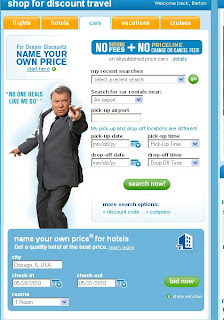 and press "Bid Now."
And now the real fun starts:

Here's the main bidding screen. First you need to select which areas of the city you're willing to stay in. Start with one (so that you have things to add later if your first bid doesn't get accepted).
Lets say you want to stay downtown. And you only want a 3 1/2 star or nicer hotel.
Select "Millennium Park" as your area, choose "4-Star Deluxe "for your star level, and put in how much you're willing to pay per night.
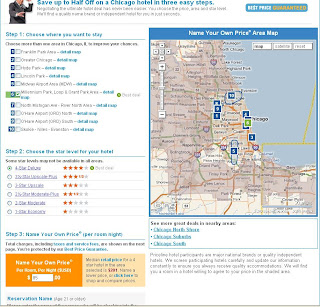
You also need to put in the name of the person the reservation will be in. And then you push "Next."
You'll get a screen that lets you review your bid:

Make sure your dates are right and check out the total price, then initial and go to the next screen, where you'll put in your credit card number. Once that's done, they'll look for a hotel room for you.
If you get a room, hooray! Success. Brag to everyone you know about what a great deal you got.
If not, it'll give you an opportunity to rebid, but you'll have to change something besides your price. You can wait 24 hours and start over. OR. . . you can add zones and star levels.
In this case, you could add 3 1/2 stars as a level you'd be willing to stay at and try again with a slightly higher price.
If it still doesn't work, add the North Michigan Avenue area and bid again (or you could do these in the opposite order and try adding a zone before you lower your star level).
And then, if you are still unsuccessful, you can start adding zones that don't have your star level, which basically is a free re-bid (meaning, you don't have to lower your standards or wait 24 hours).
If you click through the zones, you'll notice some zones only have really low-star hotels available, like Franklin Park which only goes up to a whopping 2 stars.

This means that if you add that zone to your bid but keep your star level at 3 1/2 stars or higher, you have no chance of getting something in the Franklin Park area because they don't HAVE any hotels that are 3 1/2 stars or higher. The Hyde Park zone also does not go above 2 stars, so it'd be another free rebid.
Eventually, you'll get a hotel room. And you'll rejoice, especially when you look at how much money you're saving.
Easy enough, right? Questions?
Here's a little guided tour through the whole process. Let's pretend you are going to go to Chicago for 3 nights over Memorial Day.
First, you'd go Bidding for Travel.

Scroll down until you find the state your destination city is in and click the link:

Once you're into your city, choose the hotel list:

And you'll get a list of all the hotels (by zone and then star level) that Bidding for Travel has had people win Priceline bids for in that city, with links to the hotels websites and what zones they are in:

At the top of this page, there is a long warning, which I'll repeat here. This list is not going to be hundred percent accurate! Priceline can change the star-rating for a hotel or there may be hotels that are not on the list because no one has ever posted that they've won a bid there or the zones may change unexpectedly, etc. This is just to give you a reasonably good idea of what kind of hotels you have a shot at getting in any particular zone or star level. I usually click around and look at the hotels so I know which zones or star levels I'll be unhappy with and thus which ones to avoid.
Once you have a feel for the hotels in the area, I usually go back to the main list for the city and see what people have been paying for hotels:

The one I've circled is for Memorial Day weekend. If you click the link, you'll notice that the rate on the hotel's website for those same dates is $409 per night, so $99 is a steal. This also lets you know that if you're willing to go less than a 4 star, you shouldn't have too much trouble doing it for well under $100 per night.
Now, it's time to actually go to Priceline and go to the Name Your Own Price section for hotels (but go through Ebates so you can get your 2% back):

In the screen that pops up, fill in your information:

And now the real fun starts:

Here's the main bidding screen. First you need to select which areas of the city you're willing to stay in. Start with one (so that you have things to add later if your first bid doesn't get accepted).
Lets say you want to stay downtown. And you only want a 3 1/2 star or nicer hotel.
Select "Millennium Park" as your area, choose "4-Star Deluxe "for your star level, and put in how much you're willing to pay per night.

You also need to put in the name of the person the reservation will be in. And then you push "Next."
You'll get a screen that lets you review your bid:

Make sure your dates are right and check out the total price, then initial and go to the next screen, where you'll put in your credit card number. Once that's done, they'll look for a hotel room for you.
If you get a room, hooray! Success. Brag to everyone you know about what a great deal you got.
If not, it'll give you an opportunity to rebid, but you'll have to change something besides your price. You can wait 24 hours and start over. OR. . . you can add zones and star levels.
In this case, you could add 3 1/2 stars as a level you'd be willing to stay at and try again with a slightly higher price.
If it still doesn't work, add the North Michigan Avenue area and bid again (or you could do these in the opposite order and try adding a zone before you lower your star level).
And then, if you are still unsuccessful, you can start adding zones that don't have your star level, which basically is a free re-bid (meaning, you don't have to lower your standards or wait 24 hours).
If you click through the zones, you'll notice some zones only have really low-star hotels available, like Franklin Park which only goes up to a whopping 2 stars.

This means that if you add that zone to your bid but keep your star level at 3 1/2 stars or higher, you have no chance of getting something in the Franklin Park area because they don't HAVE any hotels that are 3 1/2 stars or higher. The Hyde Park zone also does not go above 2 stars, so it'd be another free rebid.
Eventually, you'll get a hotel room. And you'll rejoice, especially when you look at how much money you're saving.
Easy enough, right? Questions?
Share To:
Apr 27, 2010
Saving on Hotels (Janssen)
If you read my personal blog, you'll know that my husband and I really love to travel. Of course, travel can get expensive, quickly, and so I'm always looking for ways to slash the cost wherever I can.
One of the best ways I've found to do this is through Priceline's "Name Your Own Price" feature for hotels. Hotel prices add up really fast, especially if you're traveling for more than a day or two, so saving fifty to a hundred dollars a night leaves you either with a smaller cost of traveling, or more money to spend actually doing things, rather than just having a place to dump your suitcase.
The basic idea is this: you select your city and then the areas of the city you're willing to stay in, the dates for your stay, a star-level of hotel, and the price you'll pay per night. Then you put in your credit card number and push okay to go ahead with your bid.
If your bid is accepted, your card is automatically charged before you ever see what hotel you're staying at. If it's not accepted, you can wait 24 hours and bid again, or change parts of your bid and try again immediately (changing the price you'll pay doesn't count - you have to add areas you'll stay in or change your star level or your dates).
I'll be the first to admit, I was a bit wary of this whole idea for a long time, because it just seemed so sketchy - you could end up with a really skeezy hotel and have no real options for getting out of it, since they charge you before you even SEE your hotel. Not my idea of a good time. But my extremely savings-savvy friend, Kristi, assured me she'd used it a bazillion times and always had good results, and I finally decided to trust her.
We've now used it a number of times and every time it's been a win. We've stayed in beautiful hotels, right in the middle of the city, in San Francisco, Boston, New York City, and Milwaukee. So no complaints from me.
You'll definitely want to use Bidding for Travel to help you use Priceline. It's a message board where people list how much they got their hotel rooms for and the site maintains a list of all the hotels they know of in specific cities that Priceline uses. Otherwise you might overbid or underbid because you have no idea what hotels in a certain city are going for (for example, when we went to Milwaukee, hotels were going for between $50-70 for a four-star hotel, while a similarly nice hotel in New York City was more like $150-200 per night).
And, of course, you can get to Priceline through Ebates (more info about Ebates here) and get 2% of your total cost back in cash. Which I never complain about (except when I forget to use Ebates and then I complain loudly to my long-suffering husband).
On Friday, I'll post step-by-step instructions (with screen shots!) about how to make a successful bid on Priceline.
One of the best ways I've found to do this is through Priceline's "Name Your Own Price" feature for hotels. Hotel prices add up really fast, especially if you're traveling for more than a day or two, so saving fifty to a hundred dollars a night leaves you either with a smaller cost of traveling, or more money to spend actually doing things, rather than just having a place to dump your suitcase.
The basic idea is this: you select your city and then the areas of the city you're willing to stay in, the dates for your stay, a star-level of hotel, and the price you'll pay per night. Then you put in your credit card number and push okay to go ahead with your bid.
If your bid is accepted, your card is automatically charged before you ever see what hotel you're staying at. If it's not accepted, you can wait 24 hours and bid again, or change parts of your bid and try again immediately (changing the price you'll pay doesn't count - you have to add areas you'll stay in or change your star level or your dates).
I'll be the first to admit, I was a bit wary of this whole idea for a long time, because it just seemed so sketchy - you could end up with a really skeezy hotel and have no real options for getting out of it, since they charge you before you even SEE your hotel. Not my idea of a good time. But my extremely savings-savvy friend, Kristi, assured me she'd used it a bazillion times and always had good results, and I finally decided to trust her.
We've now used it a number of times and every time it's been a win. We've stayed in beautiful hotels, right in the middle of the city, in San Francisco, Boston, New York City, and Milwaukee. So no complaints from me.
You'll definitely want to use Bidding for Travel to help you use Priceline. It's a message board where people list how much they got their hotel rooms for and the site maintains a list of all the hotels they know of in specific cities that Priceline uses. Otherwise you might overbid or underbid because you have no idea what hotels in a certain city are going for (for example, when we went to Milwaukee, hotels were going for between $50-70 for a four-star hotel, while a similarly nice hotel in New York City was more like $150-200 per night).
And, of course, you can get to Priceline through Ebates (more info about Ebates here) and get 2% of your total cost back in cash. Which I never complain about (except when I forget to use Ebates and then I complain loudly to my long-suffering husband).
On Friday, I'll post step-by-step instructions (with screen shots!) about how to make a successful bid on Priceline.
Share To:
Apr 26, 2010
Saving for Both Short and Long Term Goals (Carole)
Melanie, a faithful FWWL reader, asked about saving for both Long Term and Short Term goals at the same time. Haven't we all been there? If you sit down and think of all the things you really should/want to save money for, it will probably be a mighty long list. Where do you start? Most people don't have the personal discipline to prioritize their wants and needs, so they just buy everything on credit the moment they want it and soon find themselves in deep financial trouble.
There is a better way and it works every time.
First -- Write your list. Take a couple of days or weeks to work on it, as it often takes some time for all your past ideas to come to the surface. Take this time to decide what you REALLY want and need.
Second -- Divide your list into both Long Term and Short Term financial goals.
Long Term Goals might include:
Emergency fund (3 - 6 months of take-home pay saved in cash -- this money is used to cover unexpected car repairs, household repairs, major medical expenses, and possible unemployment),
A down payment on a house,
A new car paid for with cash.
Some of these long term goals aren't that exciting, but they will bring stability and safety to your future financial life. Definitely worth the effort.
Short Term Goals might include:
A new piece of furniture,
Re-carpeting a room,
A vacation.
Remember financial goals are about both wants AND needs.
Third -- Now comes the hard part. Prioritize your Long Term Goals. 1, 2, 3. . . Same with your Short Term Goals.
 You will quickly see that you cannot possibly save toward all of these at the same time, unless you have a great deal of extra money sitting around. My husband refers to this as trying to "ride your horse off in all directions at once." (He's said this to me many times over the years). If you try to spread your savings money too thinly, you will make very little progress on anything and will quickly get discouraged.
I suggest that you choose #1 from your Long Term list and #1 from your Short Term list and save for only those two. Decide how much money each of these goals needs to bring them to fruition. Then look to see how much money you can reasonably put toward each goal every month. Make yourself a chart (I LOVE CHARTS!) with completion dates. Tape the charts up somewhere you'll see them every day, so that you will keep these goals in the front of your mind. Take it from someone who has saved for dozens and dozens of things over the years -- the first few months of saving pass very, very slowly. But before you know it, it's been 6 months and your saved $ amounts begin to look pretty substantial. Those big numbers are highly motivating to keep moving forward! I've been saving up for a set of custom doors leading from my dining room to my kitchen for quite some time and just passed the $5,000 mark (these are expensive doors) and it feels GOOD. I'm ordering them soon!
The Short Term Goal will probably max out within only a few months and you can go buy whatever fabulous thing it was you wanted to get -- with cash! Celebrate not only by making your purchase, but also write across your chart in big red marker "SUCCESS!" and begin wallpapering your bathroom with these as you achieve each one OR fold up the chart and place it in your journal for future motivation. Then move onto Short Term Goal #2. You may find that some of your short term goals (possibly items #4 and below) begin to look a lot less interesting as time goes on. You'll be glad you didn't impulsively buy these items on credit and now 18 months later you're still paying for things that aren't important to you anymore. Delaying a purchase often causes your rational thinking to take control again or for you to simply change your mind. The VISA people hate that.
Your Long Term Goal may take you a few years to accomplish, but you'll get there too! It may seem like a slow process at times, but there is absolutely no other way to achieve your long term financial goals. This is where you see the value of keeping your monthly fixed expenses low. The more expensive your daily life is, the harder it is to save for your future or any extra lovely things.
By following this technique you will join that rare breed of people who save money to protect their futures and pay cash when they buy something substantial! Let me be the first to say it, "YOU are amazing!"
There is a better way and it works every time.
First -- Write your list. Take a couple of days or weeks to work on it, as it often takes some time for all your past ideas to come to the surface. Take this time to decide what you REALLY want and need.
Second -- Divide your list into both Long Term and Short Term financial goals.
Long Term Goals might include:
Emergency fund (3 - 6 months of take-home pay saved in cash -- this money is used to cover unexpected car repairs, household repairs, major medical expenses, and possible unemployment),
A down payment on a house,
A new car paid for with cash.
Some of these long term goals aren't that exciting, but they will bring stability and safety to your future financial life. Definitely worth the effort.
Short Term Goals might include:
A new piece of furniture,
Re-carpeting a room,
A vacation.
Remember financial goals are about both wants AND needs.
Third -- Now comes the hard part. Prioritize your Long Term Goals. 1, 2, 3. . . Same with your Short Term Goals.
I suggest that you choose #1 from your Long Term list and #1 from your Short Term list and save for only those two. Decide how much money each of these goals needs to bring them to fruition. Then look to see how much money you can reasonably put toward each goal every month. Make yourself a chart (I LOVE CHARTS!) with completion dates. Tape the charts up somewhere you'll see them every day, so that you will keep these goals in the front of your mind. Take it from someone who has saved for dozens and dozens of things over the years -- the first few months of saving pass very, very slowly. But before you know it, it's been 6 months and your saved $ amounts begin to look pretty substantial. Those big numbers are highly motivating to keep moving forward! I've been saving up for a set of custom doors leading from my dining room to my kitchen for quite some time and just passed the $5,000 mark (these are expensive doors) and it feels GOOD. I'm ordering them soon!
The Short Term Goal will probably max out within only a few months and you can go buy whatever fabulous thing it was you wanted to get -- with cash! Celebrate not only by making your purchase, but also write across your chart in big red marker "SUCCESS!" and begin wallpapering your bathroom with these as you achieve each one OR fold up the chart and place it in your journal for future motivation. Then move onto Short Term Goal #2. You may find that some of your short term goals (possibly items #4 and below) begin to look a lot less interesting as time goes on. You'll be glad you didn't impulsively buy these items on credit and now 18 months later you're still paying for things that aren't important to you anymore. Delaying a purchase often causes your rational thinking to take control again or for you to simply change your mind. The VISA people hate that.
Your Long Term Goal may take you a few years to accomplish, but you'll get there too! It may seem like a slow process at times, but there is absolutely no other way to achieve your long term financial goals. This is where you see the value of keeping your monthly fixed expenses low. The more expensive your daily life is, the harder it is to save for your future or any extra lovely things.
By following this technique you will join that rare breed of people who save money to protect their futures and pay cash when they buy something substantial! Let me be the first to say it, "YOU are amazing!"
Share To:
Apr 15, 2010
Re-thinking the Cabin (Carole)

But like any red-blooded American woman I began to think, "Wouldn't that be GREAT to have a lake house??" Or a mountain cabin, or a beach house or a vacation home or whatever this kind of 2nd home is called in your area. Something I'd never considered before in my life, suddenly became something I really wanted in my future. It just sounded so relaxing. . .
Luckily I have a wise mother-in-law. She mentioned to me about 20 years ago that she didn't understand the whole 2nd home idea. I was shocked. I knew she had many, many friends who had cabins and lake houses. How could she think this?? Then she told me why she wasn't interested:
1. You feel obligated to go to the same place -- EVERY YEAR. She wanted the freedom to go somewhere new when she had the inclination to get away -- anywhere in the world.
2. You have to clean it every time you go and again when you leave. On the other hand, every vacation destination pays people to not only clean things up when you leave, but they keep it clean every day that you're their guest.
3. You are always concerned about vandalism (when you're away) and seasonal maintenance. At your vacation destination, you have none of these concerns. You waltz in and you waltz out.
4. Your down payment ALONE on the property (say $20,000) could buy you 50 nights at a hotel charging $400/night. That's one terrific vacation room! If your room was only $200/night you'd be able to vacation for 100 days! And this money doesn't even count your $1000 mortgage payment (and home owners insurance) every month for 15 or 30 years.
I'm not too quick sometimes, but I began to see that her reasons made a whole lot of sense. I've joined her No Vacation House Club. Maybe you see a 2nd home as an investment. That's great. But I'd personally rather have an investment that didn't require me to clean toilets and kill mice.
To borrow (and alter) my college's motto: The World is My Vacation House.
Share To:
Apr 2, 2010
A Peek at the Promised Land (Carole)
A few weeks ago, Tara commented that she didn't see the point in being frugal, frugal, frugal just so she could be a millionaire when she and her husband are 80! What is the fun in that?? Maybe some of you have had the same thoughts as you've thought about coupon-ing, garage sale-ing, eating at home. . . Hopefully, I can give you a glimpse at where this whole Frugal Life thing is really headed.
If you have credit card debt, car loans and/or student loans, most people (when you finally get very serious about it) can pay all of it off within 3 years. We have never carried credit card debt, but we've had a few car loans and we had over $60,000 in student loans back in the 1980's -- so about $130,000 in today's money. We paid minimum payments for a number of years, and then we got religion. We paid off our car in about 8 months and our student loans in about 2 years. So we paid off all our consumer debt in right around that 3 year mark. We weren't making tons of money and we had 3 children. We were extremely average. You could probably pay things off faster than we did.
Our next step was paying off our house. We knew a couple of families our own age (early 30's) who had paid off their houses. We were AMAZED. Could we do that too?? How long would something like that take? We owed about $160,000 on our house at the time. As a little family we confronted this monumental financial goal with everything we had. We printed out an amortization schedule (numerous pages of small type -- very scary), and taped it ALL to the back of the door where the bills were paid in our house. Every month when we paid our regular house payment, we also added as much extra $$ as we could scrape out of our home budget and sent that along to the mortgage company too -- that extra money goes straight to the principle. We often gathered our 3 girls into the room while we marked off the payment amount with a highlighter pen and circled all the skipped interest payments that NEVER HAS TO BE PAID-- EVER!! Did we starve through this time? Live on nothing? Never leave the house? No, we actually took a few pretty decent vacations along the way and fed and clothed everyone. Probably saw a few movies too. But we stuck to our house payback schedule. We threw everything we could at this debt and in 3+ years we received our title, free and clear, in the mail. That is a moment never to be forgotten.
We paid that house off in 1996. In 2003 I wanted a bigger house (we had more children, the older ones were larger, and we wanted to live in a better school district). We found the house we wanted and went back into a $100,000 mortgage (we were able to pay for MOST of the house with cold, hard cash from the sale of our first house -- that felt very, very nice). We paid off this new mortgage in about 2 years. I thought I would mention here that both times we got down to the last $30,000 on our mortgage, extra money just started appearing. I can't even explain it. It's like the Lord knows you are serious about taking care of your family and your finances, so He blesses you beyond anything you've ever seen. The last $30,000 was paid off about 5 months earlier than scheduled -- both times. When you get to that point, let me know if this happens to you too!
So, when you've paid off all of your debt -- in under 5 years probably -- how does life look? It is an amazing place to be. Think of the amount of money you bring home every month in your paycheck. Now think of how much it would cost you to live with no major bills. No credit card payments, no car loans, no student loans, no house payment. Can you even wrap your mind around that?
You still have to buy food, electricity, gasoline, car insurance, clothes, property taxes. That's about it. Hmm. How much would that add up to in a month? Not very much. All the rest of your take home pay is YOURS. Wow.
What will you do with it?
Saving is a big thing. Putting as much money as you can into tax-free or tax-deferred programs is very smart.
Beyond that, you can spend it on anything you want. You could buy a new car with cash -- every few months! You could buy a brand new boat in cash, also in just a few months. You could redecorate your entire house. Put in a backyard pool. You can be generous beyond anything you can imagine. Travel to Europe, Asia, Africa -- every few months. All for cash.
You will finally be free. All the hard work you (or your spouse) puts in to bring home money, will finally benefit YOU. All in about 5 years.
Enjoy.
If you have credit card debt, car loans and/or student loans, most people (when you finally get very serious about it) can pay all of it off within 3 years. We have never carried credit card debt, but we've had a few car loans and we had over $60,000 in student loans back in the 1980's -- so about $130,000 in today's money. We paid minimum payments for a number of years, and then we got religion. We paid off our car in about 8 months and our student loans in about 2 years. So we paid off all our consumer debt in right around that 3 year mark. We weren't making tons of money and we had 3 children. We were extremely average. You could probably pay things off faster than we did.
Our next step was paying off our house. We knew a couple of families our own age (early 30's) who had paid off their houses. We were AMAZED. Could we do that too?? How long would something like that take? We owed about $160,000 on our house at the time. As a little family we confronted this monumental financial goal with everything we had. We printed out an amortization schedule (numerous pages of small type -- very scary), and taped it ALL to the back of the door where the bills were paid in our house. Every month when we paid our regular house payment, we also added as much extra $$ as we could scrape out of our home budget and sent that along to the mortgage company too -- that extra money goes straight to the principle. We often gathered our 3 girls into the room while we marked off the payment amount with a highlighter pen and circled all the skipped interest payments that NEVER HAS TO BE PAID-- EVER!! Did we starve through this time? Live on nothing? Never leave the house? No, we actually took a few pretty decent vacations along the way and fed and clothed everyone. Probably saw a few movies too. But we stuck to our house payback schedule. We threw everything we could at this debt and in 3+ years we received our title, free and clear, in the mail. That is a moment never to be forgotten.
We paid that house off in 1996. In 2003 I wanted a bigger house (we had more children, the older ones were larger, and we wanted to live in a better school district). We found the house we wanted and went back into a $100,000 mortgage (we were able to pay for MOST of the house with cold, hard cash from the sale of our first house -- that felt very, very nice). We paid off this new mortgage in about 2 years. I thought I would mention here that both times we got down to the last $30,000 on our mortgage, extra money just started appearing. I can't even explain it. It's like the Lord knows you are serious about taking care of your family and your finances, so He blesses you beyond anything you've ever seen. The last $30,000 was paid off about 5 months earlier than scheduled -- both times. When you get to that point, let me know if this happens to you too!
So, when you've paid off all of your debt -- in under 5 years probably -- how does life look? It is an amazing place to be. Think of the amount of money you bring home every month in your paycheck. Now think of how much it would cost you to live with no major bills. No credit card payments, no car loans, no student loans, no house payment. Can you even wrap your mind around that?
You still have to buy food, electricity, gasoline, car insurance, clothes, property taxes. That's about it. Hmm. How much would that add up to in a month? Not very much. All the rest of your take home pay is YOURS. Wow.
What will you do with it?
Saving is a big thing. Putting as much money as you can into tax-free or tax-deferred programs is very smart.
Beyond that, you can spend it on anything you want. You could buy a new car with cash -- every few months! You could buy a brand new boat in cash, also in just a few months. You could redecorate your entire house. Put in a backyard pool. You can be generous beyond anything you can imagine. Travel to Europe, Asia, Africa -- every few months. All for cash.
You will finally be free. All the hard work you (or your spouse) puts in to bring home money, will finally benefit YOU. All in about 5 years.
Enjoy.
Share To:
Mar 10, 2010
Flying for Free (Carole)

Don’t try this at home.
I’ve mentioned in the past, that my husband and I do not have a personal credit card. This is still true. However, we own a business, and the business has a credit card, and has from the day we opened our doors. We’ve used several different credit cards over the past 20+ years, but none have given us the fantastic rewards that we’ve earned in the last 2 years with our Southwest Airline Rapid Rewards VISA credit card.
16 Rapid Rewards credits earn us a free round-trip ticket anyplace Southwest Airlines flies!! You have to spend $1200 on your card to earn one credit. That means that a round trip ticket costs you $19,200 in credit card purchases. Now, if I were trying to earn a free ticket through this credit card on a home account, it would probably take me a whole year to earn one ticket. But a business has much larger bills than a home does, and many, many of those bills can be paid with a credit card. Our little business earns us one free round-trip ticket nearly every month. That is something to shout about!
We’ve used other credit cards in the past that offered Sky Miles or other kinds of travel deals. And even though we were spending the same amounts of cash with them, it always took over a year to earn even one round trip ticket – and then there were so many restrictions and black-out days, that it was hardly worth the trouble. Often, our Sky Miles points would not cover the entire cost of the ticket. I don’t know what weird formula these other card companies use, but it certainly wasn’t in our favor.
Southwest Airlines though offers a very simple program, and it has really worked for us. We’ve been able to use our RR credits for many free trips over the past couple of years, we’ve also flown our children out to visit, and helped out a few others who have had a need. They’ve been such a blessing.
Like any credit card, we treat this business card with great care. We watch our purchases very carefully, we try to use it mainly to pay monthly bills, and we pay it off EVERY MONTH.
If you have difficulty with any of those three items, then stay away from any and all credit cards in your business. Work with cash.
But if this seems like it could work for you, take my word for it – it’s a great deal.
Share To: